Welcome to our in-depth exploration of the fascinating world of anatomy and physiology! In this article, we will unravel the key differences between these two closely related fields of study. So, let’s dive right in and discover how anatomy and physiology differ and how they come together to provide a comprehensive understanding of the human body.
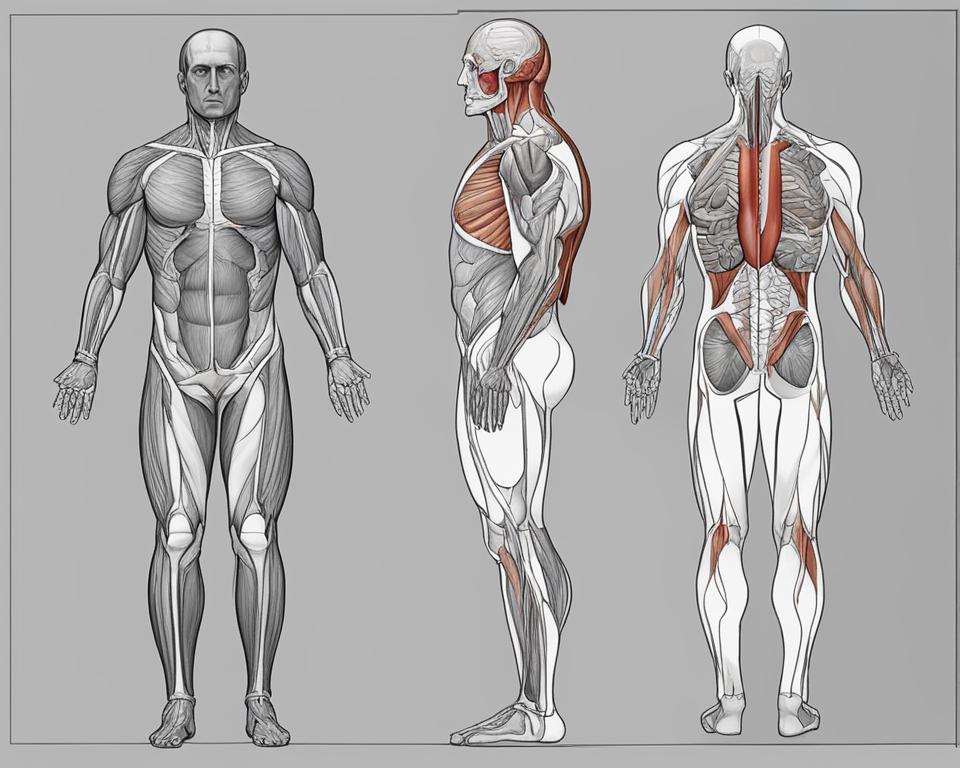
Key Takeaways:
- Anatomy focuses on the structure and identity of body parts, while physiology delves into how these parts function and relate to one another.
- Gross anatomy examines visible structures, while microscopic anatomy explores cellular structures.
- Physiology covers a broad range of topics, from cellular functions to whole-body processes.
- Anatomy provides the foundation for understanding the form and location of organs and tissues, while physiology explains how these structures work.
- Both anatomy and physiology are essential for medical professionals and researchers to gain insight into the complex interactions and functions of the human body.
Anatomy: The Study of Body Structures
Anatomy is a branch of biology that focuses on the study of the structure and physical positioning of body parts. It is a fundamental discipline that provides a foundation for understanding the human body. By exploring the intricacies of anatomical structures, researchers and medical professionals gain valuable insights into how the body is organized and how different parts interact.
Gross anatomy, also known as macroscopic anatomy, is a subfield of anatomy that deals with the visible structures of the body. It involves the examination of organs, tissues, and structures that can be observed with the naked eye. Gross anatomy plays a crucial role in identifying and understanding the major systems and structures of the body. Through careful examination and dissection, researchers can study the external appearance, location, and relationships between various organs and tissues.
Microscopic anatomy, on the other hand, delves into the finer details of cellular structures. It involves the study of cells and tissues at a microscopic level, using specialized microscopes and staining techniques. Microscopic anatomy allows researchers to explore the morphology and function of individual cells, as well as the organization and arrangement of tissues. This branch of anatomy is essential for understanding the cellular basis of bodily functions and processes.
The Importance of Anatomy
“Anatomy is the foundation upon which the understanding of the human body is built. By dissecting and studying its components, we gain insights into the form and function of organs and tissues, paving the way for further advancements in medical knowledge.” – Dr. Jane Chambers, Anatomy Professor
Anatomy is a vital field of study that provides essential knowledge for various professions, including medicine, biology, and physical therapy. It helps medical professionals diagnose and treat diseases, perform surgeries, and understand the effects of medications on the body. Additionally, anatomical knowledge plays a crucial role in research and innovation, enabling scientists to develop new treatments and technologies that improve human health.
Gross Anatomy versus Microscopic Anatomy: A Comparison
To further understand the distinction between gross anatomy and microscopic anatomy, let’s compare these two subfields:
| Gross Anatomy | Microscopic Anatomy |
|---|---|
| Focuses on visible structures | Examines cells and tissues at a microscopic level |
| Studies the external appearance and relationships between organs and tissues | Explores the morphology and function of individual cells |
| Involves dissection and observation with the naked eye | Utilizes specialized microscopes and staining techniques |
| Provides a broad overview of the body’s systems and structures | Offers detailed insights into cellular organization and function |
| Examples: identifying organs, analyzing bone structure | Examples: studying cell types, examining tissue architecture |
Both gross anatomy and microscopic anatomy are essential for understanding the complexities of the human body. While gross anatomy provides a macroscopic view and allows for the identification of structures, microscopic anatomy delves into the cellular and tissue level, providing a more detailed understanding of their functions. Together, these two branches of anatomy form a comprehensive framework for exploring the intricacies of the human body and its systems.
Physiology: The Study of Body Functions
In the field of biology, physiology is the study of how living organisms and their organ systems function. It encompasses a wide range of topics, from the inner workings of individual cells to the complex interactions between different organ systems in the body. By examining the chemical, physical, and electrical activities happening within an organism, physiology provides valuable insights into the mechanisms that enable life.
Cell physiology is a fundamental branch of physiology that explores how individual cells carry out their functions. It investigates the processes happening within cells, such as metabolic reactions, signaling pathways, and the transportation of molecules. System physiology, on the other hand, focuses on the interactions between different organ systems in the body. It examines how these systems work together to maintain homeostasis, adapt to changes in the environment, and carry out various processes necessary for life.
Physiology plays a crucial role in understanding the intricacies of the human body and how it functions in both health and disease. It provides insights into the mechanisms behind biological processes such as digestion, respiration, circulation, and excretion. By studying physiology, researchers and medical professionals gain a deeper understanding of how different physiological systems work together to ensure the body’s overall well-being.
System Physiology: An Overview
System physiology is an essential branch of physiology that examines how different organ systems in the body function and interact with one another. Here are some key aspects of system physiology:
- Respiratory system: Study of the organs and processes involved in respiration, including the lungs, diaphragm, and gas exchange.
- Cardiovascular system: Investigation of the heart, blood vessels, and circulation, focusing on the delivery of oxygen and nutrients throughout the body.
- Endocrine system: Analysis of hormones and their effects on regulating various bodily functions, such as growth, metabolism, and reproduction.
- Nervous system: Examination of the brain, spinal cord, and peripheral nerves, studying how they coordinate and control bodily functions and responses.
- Renal system: Exploration of the kidneys, ureters, bladder, and urethra, investigating the processes involved in urine formation and the regulation of electrolyte balance.
- Musculoskeletal system: Study of the skeletal system, muscles, and their interactions, focusing on movement, support, and protection of the body.
These are just a few examples of the numerous organ systems studied in system physiology. Each system is essential for the overall functioning of the human body and requires coordination and integration with other systems to maintain homeostasis.
The Significance of Physiology
Physiology is the key to unlocking the secrets of life. It provides us with a deep understanding of how our bodies work, allowing us to pursue advancements in medicine, improve health outcomes, and enhance our overall well-being.
Physiology is not limited to humans; it encompasses the study of various organisms across the animal kingdom. By comparing and contrasting physiological processes in different species, scientists can gain insights into evolutionary adaptations and develop a broader understanding of life on Earth.
Overall, the study of physiology is vital for scientists, researchers, and medical professionals to uncover the intricate workings of the human body and develop strategies for promoting health and preventing disease.
Anatomy and Physiology Relationship
Anatomy and physiology are two disciplines that go hand in hand, each providing valuable insights into the intricate workings of the human body. While anatomy focuses on the structure and physical attributes of body parts, physiology delves into their functions and interactions. Despite their differences, there is a strong connection between anatomy and physiology, with both fields complementing and informing each other.
One of the key similarities between anatomy and physiology is the shared terminology used to describe the human body. Both disciplines rely on a standardized language to identify and communicate the location, planes, and regions of organs and tissues. This common vocabulary serves as a bridge between anatomy and physiology, enabling a seamless flow of information between the two fields.
Additionally, anatomy provides the foundation for understanding physiology. Knowledge of the structure and position of body parts is crucial in comprehending their functions. For example, understanding the intricacies of the heart’s chambers and valves (anatomy) helps explain how blood is pumped throughout the body (physiology). Similarly, knowledge of the structure of the lungs allows us to understand how oxygen is exchanged within the body.
| Anatomy | Physiology |
|---|---|
| Focuses on the structure and physical attributes of body parts. | Examines the functions and behaviors of body parts. |
| Provides the foundation for understanding physiology. | Relies on the knowledge of anatomy for a comprehensive understanding. |
| Uses the same terminology to describe body planes, regions, and organ locations. | Utilizes a standardized language to communicate the workings of the body. |
The relationship between anatomy and physiology can be likened to a lock and key. Anatomy provides the lock, representing the structure and form, while physiology acts as the key, unlocking the mechanisms and functions that bring the body to life.
Anatomy vs Physiology: Key Differences
While anatomy and physiology are closely related disciplines that study the human body, they differ in their focus of study. Anatomy is concerned with the structure and physical positioning of body parts, while physiology examines the functions and behaviors of those parts. In other words, anatomy answers the question of “what” and “where,” while physiology delves into the question of “how” and “why.”
Anatomy is a static study that often involves dissections or the use of medical imaging techniques to examine the body’s structures. It provides a visual representation of the body’s organization and spatial relationships. Physiology, on the other hand, is a dynamic study that investigates the chemical, physical, and electrical activities happening within an organism’s body. It explores how different organs and systems work together to maintain homeostasis and carry out various processes necessary for life.
“Anatomy provides the groundwork for physiology to understand how the body operates.”
Understanding the differences between anatomy and physiology is essential for gaining a comprehensive understanding of the human body. While anatomy provides the structural foundation, physiology complements it by explaining the mechanisms behind the body’s functions. Both disciplines are interconnected and play a crucial role in the field of medicine, as they help healthcare professionals diagnose, treat, and prevent various diseases and disorders.
| Key Differences | Anatomy | Physiology |
|---|---|---|
| Focus | Structure and physical positioning of body parts | Functions and behaviors of body parts |
| Study Methods | Dissections, medical imaging | Chemical, physical, and electrical activities |
| Question Answered | “What” and “where” | “How” and “why” |
By exploring both anatomy and physiology, we gain a deeper understanding of the human body’s complexity and how it functions to sustain life. These fields of study provide a valuable foundation for medical professionals, researchers, and students looking to unravel the mysteries of the human body.
Anatomy and Physiology: Essential Topics
When studying anatomy and physiology, students encounter various branches and topics that provide a comprehensive understanding of the human body. This section will explore some of the essential areas covered in both disciplines.
Gross Anatomy
Gross anatomy focuses on the visible structures of the body. It examines organs, tissues, and systems that can be observed without the need for a microscope. This branch of anatomy provides a foundation for understanding the overall structure and organization of the human body.
Microscopic Anatomy
Microscopic anatomy involves the study of cells, tissues, and organs at a microscopic level. It explores the intricate structures and functions that cannot be seen with the naked eye. Histology, which focuses on tissues, and cytology, which examines cells, are subfields of microscopic anatomy.
Systemic Anatomy
Systemic anatomy focuses on the study of the different organ systems in the body. It involves understanding the structure and function of each system, such as the cardiovascular, respiratory, digestive, nervous, and skeletal systems. Systemic anatomy provides insights into how these systems work together to maintain overall health.
Other important branches of anatomy and physiology include regional anatomy (the study of specific body regions) and embryology (the study of prenatal development). Additionally, in physiology, students explore topics such as cellular physiology (the functions of cells), system physiology (how organ systems work together), evolutionary physiology (adaptations in organisms), defense physiology (the body’s response to threats), and exercise physiology (the effects of physical activity on the body).
By studying these various branches and topics, individuals gain a deeper understanding of the intricacies of the human body, paving the way for advancements in medical research, healthcare, and overall well-being.
Conclusion
In conclusion, anatomy and physiology are two interconnected fields that play a crucial role in understanding the structure and function of living organisms. Anatomy focuses on the physical structures and locations of body parts, while physiology delves into how these parts work and interact to maintain the body’s optimal functioning.
By studying anatomy, we gain insights into the form and positioning of organs and tissues, providing a foundation for understanding their function. Physiology, on the other hand, allows us to explore the dynamic processes happening within the body, from cellular functions to the interactions between different organ systems.
Together, anatomy and physiology provide a comprehensive understanding of the complex mechanisms that enable life. Whether you’re a medical professional, researcher, or simply interested in learning about the human body, these fields are essential for gaining valuable insights into our own health and well-being.
FAQ
What is the difference between anatomy and physiology?
Anatomy is the study of the structure and identity of body parts, while physiology is the study of how these parts function and relate to one another.
What does anatomy focus on?
Anatomy focuses on the internal and outward appearance of an organism.
What does physiology focus on?
Physiology looks at the functioning and behavior of cells, tissues, and organs.
Are anatomy and physiology taught together?
Yes, they are often taught together in college courses.
What is gross anatomy?
Gross anatomy focuses on the visible structures that can be observed with the naked eye.
What is microscopic anatomy?
Microscopic anatomy delves into the finer details of cellular structures.
What is the importance of anatomy?
Anatomy is crucial for understanding the form and location of organs and tissues, providing a foundation for physiology.
What does physiology study?
Physiology is the study of how living organisms and their organ systems function.
What does cell physiology explore?
Cell physiology explores how individual cells work together.
What does systemic physiology focus on?
Systemic physiology focuses on the interactions between different organ systems in the body.
How are anatomy and physiology related?
Both anatomy and physiology study the human body and use the same terminology to describe body planes, regions, and organ locations.
What is the main difference between anatomy and physiology?
Anatomy is concerned with the structure and physical positioning of body parts, while physiology examines the functions and behaviors of those parts.
What are the main areas of study in anatomy and physiology?
In anatomy, students learn about gross anatomy, microscopic anatomy, regional anatomy, and systemic anatomy. In physiology, areas of study include cellular physiology, system physiology, evolutionary physiology, defense physiology, and exercise physiology.
Why are anatomy and physiology important?
Both disciplines are essential for medical professionals and researchers to gain insight into the human body’s complex interactions and functions.
What is the relationship between anatomy and physiology?
Understanding the anatomy of an organism is crucial for comprehending its physiology, as the form and position of organs and tissues directly impact their function.