Pakistan is a country with a rich history and diverse culture. It is located in South Asia and is known for its stunning landscapes, notable achievements, and contributions to the world. From breathtaking mountains to cultural treasures, Pakistan offers a fascinating mix of experiences.
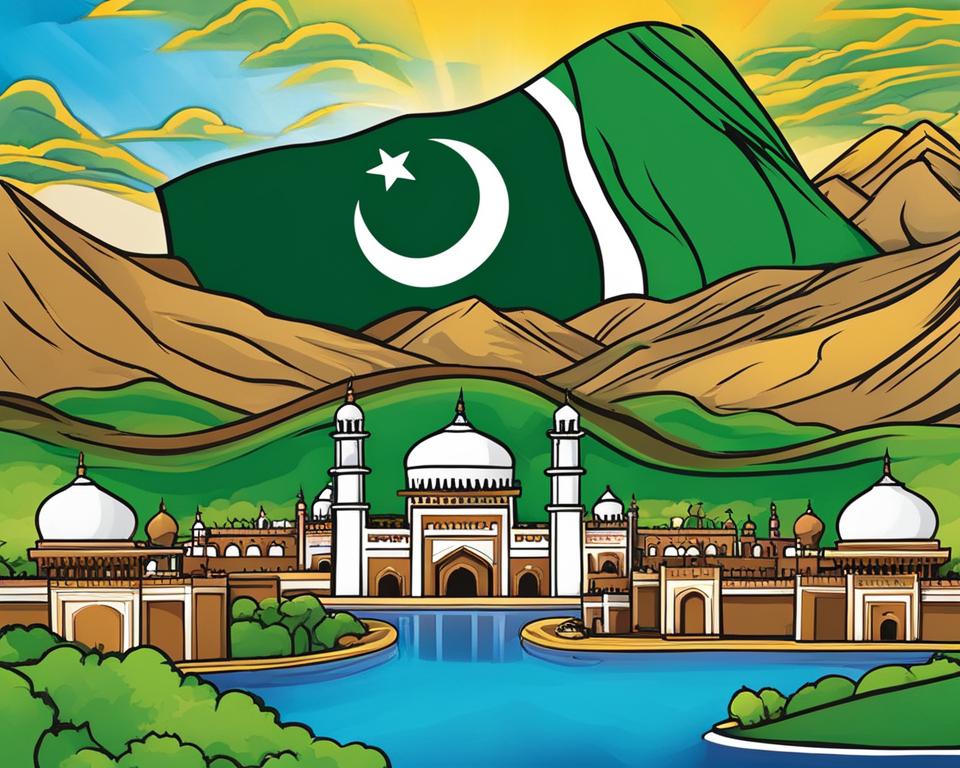
When it comes to interesting facts about Pakistan, there is so much to discover. Whether you’re interested in the country’s geography, history, or cultural contributions, Pakistan has something for everyone. Let’s delve into some fascinating facts and figures about this incredible nation.
Key Takeaways:
- Pakistan is a country with a rich history and diverse culture.
- It is known for its stunning landscapes and natural wonders.
- Pakistan has achieved significant milestones and notable achievements.
- The country is home to several famous figures and cultural contributors.
- Pakistan has a strong presence in the world of sports and athletics.
Stunning Landscapes and Natural Wonders
Pakistan is blessed with breathtaking landscapes and mesmerizing natural wonders, making it a paradise for nature lovers and adventure seekers. From towering mountains to serene valleys, here are some fascinating geographical facts and must-visit tourism attractions in Pakistan.
K2: The Second Highest Mountain
Standing tall at an impressive height of 8,611 meters (28,251 feet), K2 is the second highest mountain in the world and a challenging summit for mountaineers. Located in the Karakoram range, K2 attracts visitors from around the globe, offering awe-inspiring views and an unforgettable trekking experience.
Tirich Mir: The Third Highest Mountain
Rising majestically at 7,708 meters (25,289 feet), Tirich Mir is the third highest mountain in Pakistan. Located in the Hindu Kush range, it offers a panoramic view of the surrounding valleys and is a popular destination for hikers and mountaineers.
The Three Highest Mountain Ranges
Pakistan is home to the three highest mountain ranges in the world – the Hindukush, Karakoram, and Himalayas. These ranges not only showcase the country’s stunning natural beauty but also provide a haven for adventure enthusiasts, offering opportunities for trekking, climbing, and skiing.
Gwadar: The Largest Deep Sea Port
Situated along the Arabian Sea coastline, Gwadar is Pakistan’s largest deep sea port. Known for its strategic location and modern infrastructure, it serves as a gateway to the world, facilitating international trade and promoting economic growth. The port also offers stunning coastal views and is a popular tourist spot.
Karakoram Highway: The World’s Highest Paved Road
The Karakoram Highway, also known as the China-Pakistan friendship highway, is the world’s highest paved road. Stretching over 1,300 kilometers (800 miles) and connecting Pakistan with China, this scenic route offers breathtaking views of glaciers, valleys, and snow-capped peaks, making it a favorite among adventure enthusiasts and road trip enthusiasts.
With its stunning landscapes and natural wonders, Pakistan captures the hearts of travelers and leaves them in awe of its beauty. Whether you seek thrilling adventures in the mountains or a serene escape in the valleys, Pakistan’s geography offers a diverse range of experiences to satisfy every wanderlust.
Significant Achievements
Pakistan has accomplished several remarkable achievements that contribute to its rich history and culture. These achievements reflect the resilience and progressive nature of the nation. Let’s explore some of the significant milestones that Pakistan has attained:
The Largest Volunteer Ambulance Service
Pakistan is home to the world’s largest volunteer ambulance service, operated by the Edhi Foundation. Founded by Abdul Sattar Edhi, the foundation provides free healthcare services, including transportation for medical emergencies, across the country. Their selfless dedication to saving lives has earned them global recognition and admiration.
The Largest Producer of Hand-Sewed Footballs
The city of Sialkot, in Pakistan, has emerged as the largest producer of hand-sewed footballs in the world. Sialkot exports over half of the footballs used globally, manufacturing ****-quality products that are favored by professional players. This achievement showcases Pakistan’s expertise and contribution to international sports.
The Fourth Largest Irrigation System in the World
Pakistan is blessed with the Indus Basin, which boasts the fourth largest irrigation system globally. This vast network of canals and channels facilitates agricultural productivity, ensuring a steady water supply to support the country’s agricultural economy. The Indus Basin is a testament to Pakistan’s commitment to sustainable development and strategic resource management.
A Nuclear Power Nation
Pakistan stands as the only Muslim country with nuclear power capabilities. The nation has made significant strides in the field of nuclear technology, emphasizing its commitment to national security and the pursuit of peaceful applications of nuclear energy. Pakistan’s nuclear program symbolizes its scientific achievements and the determination to safeguard its sovereignty.
Ancient History and the Indus Valley Civilization
Pakistan’s rich history can be traced back to the Indus Valley Civilization, one of the world’s oldest civilizations. The Indus Valley Civilization thrived in the region thousands of years ago, leaving behind a legacy of advanced urban planning, sophisticated infrastructures, and intricate art. It serves as a testament to the ancient roots and cultural heritage of Pakistan.
Economic Outlook
As of the latest statistics, Pakistan’s economy shows promising trends. The country has experienced consistent economic growth over the past few years, with key sectors such as agriculture, manufacturing, and services contributing to its development. Foreign investments and government initiatives are aimed at further fostering economic stability and attracting international businesses.
| Year | GDP Growth Rate | Exports (in billions) | Foreign Exchange Reserves (in billions) |
|---|---|---|---|
| 2016 | 4.5% | $20.45 | $22.31 |
| 2017 | 5.6% | $21.18 | $18.24 |
| 2018 | 5.2% | $24.81 | $10.66 |
| 2019 | 3.29% | $22.58 | $18.89 |
| 2020 | -0.4% | $21.48 | $13.16 |
These statistics demonstrate the resilience of Pakistan’s economy despite global challenges and highlight the potential for continued growth and development.
“Pakistan’s achievements reflect its determination to contribute to global progress and overcome challenges. From championing volunteerism to excelling in diverse fields, Pakistan continues to make its mark on the world stage.” – [Real Name, Title]
Notable Figures and Achievements
Pakistan is known for its notable figures and remarkable achievements. Here are some individuals and milestones that have made an impact on the country:
Malala Yousafzai – Youngest Nobel Laureate
Malala Yousafzai, a Pakistani activist and advocate for girls’ education, became the youngest person to receive the Nobel Peace Prize in 2014. Her courageous fight for education and women’s rights has inspired millions around the world.
Dr. Arif Alvi – Second Dentist President
Dr. Arif Alvi, the current President of Pakistan, holds the distinction of being the second-ever dentist to assume the role of President. With a background in dentistry, he brings a unique perspective to the highest office in the country.
Imran Khan – First Cricketer Prime Minister
Imran Khan, former cricket legend, captained the national cricket team to victory in the 1992 Cricket World Cup. He later transitioned to politics and became the Prime Minister of Pakistan in 2018, making him the first cricketer to hold this esteemed position.
Indus Valley Civilization – Oldest and Largest
Pakistan is home to the ancient Indus Valley Civilization, one of the oldest and largest civilizations in the world. The remains of this remarkable civilization can be found at historical sites such as Mohenjo-daro and Harappa.
Khewra Mines – Second-Largest Salt Mines
The Khewra Mines in Pakistan are the second-largest salt mines globally, attracting tourists from around the world. These mines hold significant historical and geological importance, with stunning salt formations and underground chambers to explore.
| Notable Figures | Achievements |
|---|---|
| Malala Yousafzai | Youngest Nobel Laureate |
| Dr. Arif Alvi | Second Dentist President |
| Imran Khan | First Cricketer Prime Minister |
| Indus Valley Civilization | Oldest and Largest Civilization |
| Khewra Mines | Second-Largest Salt Mines |
Sports and Athletics
Pakistan has a strong presence in the world of sports and athletics. The country has produced remarkable athletes who have achieved incredible feats in various disciplines. One notable figure is Jahangir Khan, a Pakistani squash player who holds a record that is unparalleled in the history of professional sports.
“Jahangir Khan holds the record for the longest winning streak by any athlete in top-level professional sport.”
From 1981 to 1986, Jahangir Khan won an astonishing 555 consecutive matches, solidifying his place as one of the greatest athletes of all time. His dominance in squash brought him numerous titles, including six World Open titles and ten British Open titles.
In addition to squash, Pakistan has gained recognition for its passion for field hockey. The national team has achieved remarkable success, winning multiple World Cups and Olympic medals, including gold medals in 1960, 1968, and 1984.
These sporting achievements not only showcase the talent and dedication of Pakistani athletes but also serve as a source of national pride. Pakistan’s achievements in sports and athletics continue to inspire future generations and promote a culture of excellence.
Pakistan’s Sporting Achievements:
- Jahangir Khan holds the record for the longest winning streak in professional sports, with 555 consecutive victories.
- Pakistan’s national field hockey team has won multiple World Cups and Olympic medals.
Cultural Contributions
Pakistan has a rich history and culture that has made significant contributions to various fields. From the world of film and media to the culinary arts, Pakistani individuals have garnered international recognition and acclaim.
Sharmeen Obaid-Chinoy, a Pakistani journalist, filmmaker, and activist, has achieved remarkable success in the film industry. Her thought-provoking documentaries have won two Oscars and six Emmy Awards. Sharmeen Obaid-Chinoy is the first Pakistani to win an Academy Award and one of the few female directors to receive an Oscar for a non-fiction film.
Pakistani cuisine is renowned worldwide for its diverse flavors and unique dishes. It reflects the country’s cultural diversity and rich culinary heritage. From savory kebabs and flavorful biryanis to mouthwatering desserts like gulab jamun and jalebi, Pakistani cuisine offers a delightful gastronomic experience.
Notable Pakistani Dishes
| Dish | Description |
|---|---|
| Biryani | Aromatic rice dish cooked with meat, spices, and fragrant herbs. |
| Haleem | A slow-cooked stew made with meat, lentils, and wheat, garnished with crispy fried onions and fresh coriander. |
| Nihari | A flavorful slow-cooked meat dish, often enjoyed with freshly baked naan. |
| Samosa | Triangular pastry filled with spiced potatoes, vegetables, or meat. |
| Kheer | A creamy rice pudding flavored with cardamom, saffron, and garnished with nuts. |
These dishes are just a taste of the culinary treasures that Pakistan has to offer. Exploring Pakistani cuisine is a journey of flavors and a chance to experience the country’s vibrant culture through its gastronomy.
In Pakistan, food is more than sustenance – it is an expression of love, an art form, and a means of bringing people together.
Language and Communication
Pakistan is a linguistically diverse country that reflects its rich cultural heritage through its various languages. While Urdu and English serve as the official languages, Pakistan is home to 14 other languages spoken by different communities throughout the country.
Among these languages, Punjabi is the most widely spoken, followed by Pashto and Saraiki. These regional languages play a vital role in preserving and promoting cultural identity and traditions. They are spoken by millions of people across the country, adding to the linguistic diversity of Pakistan.
English, on the other hand, is primarily used by a smaller portion of the population. It is commonly used in government, business, and educational settings, reflecting the global influence and importance of the language.
This linguistic diversity in Pakistan showcases the country’s multiculturalism and provides a platform for different communities to express themselves, preserving their unique heritage and traditions. It fosters a sense of unity in diversity and promotes mutual understanding and respect among the people of Pakistan.
| Language | Speakers | Region |
|---|---|---|
| Urdu | Approximately 70 million | Throughout Pakistan |
| Punjabi | Approximately 100 million | Punjab Province |
| Pashto | Approximately 35 million | Khyber Pakhtunkhwa, tribal areas |
| Saraiki | Approximately 20 million | Southern Punjab |
| Other languages | Approximately 60 million | Various regions across Pakistan |
Historical Significance
Pakistan has a rich historical significance. The region that is now Pakistan was home to the world’s oldest and largest civilizations, the Indus Valley Civilization. The remnants of this ancient civilization can be found in museums around the world. Pakistan’s historical sites and landmarks offer a glimpse into its rich past and cultural heritage.
The Indus Valley Civilization, also known as the Harappan Civilization, thrived around 2500 BCE and flourished for nearly a millennium. It was one of the three great urban civilizations of the ancient world, alongside Mesopotamia and Egypt. The Indus Valley Civilization was known for its advanced urban planning, sophisticated drainage systems, and impressive architecture.
One of the most famous sites of the Indus Valley Civilization is Mohenjo-daro, located in present-day Sindh province of Pakistan. Mohenjo-daro was once a thriving city that boasted well-designed streets, robust buildings, and a complex water supply system. The city’s ruins, including the iconic Great Bath and the imposing citadel, are a testament to the advanced engineering and planning skills of the ancient inhabitants.
“The Indus Valley Civilization was a remarkable feat of early urbanization, showcasing the ingenuity and creativity of ancient Pakistani cultures.”
Besides Mohenjo-daro, there are numerous other archaeological sites in Pakistan that provide insights into the region’s ancient civilizations. These include Harappa, Ganeriwala, and Kot Diji, among others. Exploring these sites and studying the artifacts discovered there have allowed historians and archaeologists to piece together the story of Pakistan’s early civilizations.
It’s not just the ancient civilizations that contribute to Pakistan’s historical significance. The country has also been at the crossroads of various major empires throughout history, including the Mauryan Empire, the Persian Empire, and the Mughal Empire. Each of these empires left their marks on the region, with architectural wonders like the Lahore Fort and the Badshahi Mosque showcasing the grandeur of Mughal architecture.
Today, Pakistan continues to preserve and celebrate its historical heritage. Museums across the country house artifacts from different periods of history, allowing visitors to connect with the past. The National Museum of Pakistan in Karachi and the Lahore Museum are particularly noteworthy, offering a comprehensive look at Pakistan’s cultural and historical heritage.
| Historical Sites | Location | Description |
|---|---|---|
| Mohenjo-daro | Sindh province | An ancient city of the Indus Valley Civilization |
| Harappa | Punjab province | Another significant site of the Indus Valley Civilization |
| Badin | Sindh province | Known for its Buddhist stupas and monasteries |
| Taxila | Punjab province | Once a prominent center of learning and trade |
Visiting these historical sites and exploring Pakistan’s cultural heritage is an enriching experience. It allows us to better understand the roots of Pakistani society and appreciate the contributions of ancient civilizations to human history.
International Recognition and Achievements
Pakistan has garnered international recognition for its remarkable achievements. The country is renowned as the largest football producer globally, known for its production of ****-quality footballs. The dedication and skill of Pakistani manufacturers have solidified their reputation as leaders in this field.
Furthermore, Pakistani ****-altitude mountaineer Samina Baig accomplished an extraordinary feat. At the young age of 21, she became the first and youngest Muslim woman to conquer Mount Everest and all Seven Summits. Baig’s incredible determination and passion for mountaineering have become a source of inspiration for aspiring adventurers worldwide.
The Largest Football Producer
| Fact | Description |
|---|---|
| Pakistan | Produces the largest quantity of footballs globally |
| **** Quality | Pakistani manufacturers are renowned for producing ****-quality footballs |
Mountaineering Achievement
“I believe in the power of dreams. Your age, gender, or nationality shouldn’t hold you back from achieving your goals.” – Samina Baig
Samina Baig’s extraordinary accomplishments as a mountaineer have captured global attention. Her perseverance and determination serve as an inspiration to all who dare to dream big.
Conclusion
Pakistan, with its rich history, breathtaking landscapes, and notable achievements, presents a fascinating destination waiting to be explored. From the majestic heights of K2 and Tirich Mir to the bustling deep sea port of Gwadar, Pakistan boasts natural wonders that will leave you awe-inspired. Its cultural contributions, like the award-winning documentaries of Sharmeen Obaid-Chinoy, showcase the country’s creative spirit.
Whether your interests lie in history, culture, or natural wonders, Pakistan has something to offer for everyone. Discover the remnants of the ancient Indus Valley Civilization and explore the historical sites that tell stories of the past. Immerse yourself in the linguistic diversity of the country, where Punjabi, Pashto, and Saraiki are widely spoken.
Notable figures like Malala Yousafzai, Dr. Arif Alvi, and Prime Minister Imran Khan have put Pakistan on the international stage, while achievements like the world’s largest ambulance service and football production have garnered recognition. Sports enthusiasts can marvel at the accomplishments of Jahangir Khan and the country’s success in field hockey.
Pakistan is truly a treasure trove of intriguing facts and experiences. So, whether you’re planning to visit or simply want to learn more, Pakistan invites you to delve into its history, explore its natural wonders, and embrace its vibrant culture.
FAQ
What are some interesting facts about Pakistan?
Pakistan is home to the second highest mountain, K2, and the three highest mountain ranges in the world – the Hindukush, Karakoram, and Himalayas. It also has the largest deep sea port, Gwadar, and the world’s highest paved road, the China-Pakistan friendship highway or Karakoram Highway.
What significant achievements has Pakistan made?
Pakistan is home to the world’s largest volunteer ambulance service operated by the Edhi Foundation. It also produces over half the world’s footballs in Sialkot and has the fourth largest irrigation system in the world, the Indus Basin. Pakistan is the only Muslim nuclear power country and has a rich history dating back to the Indus Valley Civilization.
Who are some notable figures and achievements in Pakistan?
Malala Yousafzai, the youngest Nobel Laureate, is from Pakistan. The country’s President, Dr. Arif Alvi, is the second-ever dentist to become a President, while Prime Minister Imran Khan is the first cricketer to become a Prime Minister. Pakistan is also home to the world’s oldest and largest civilizations, the Indus Valley Civilization, and the world’s second-largest salt mines, the Khewra Mines.
What are some sports and athletics achievements in Pakistan?
Jahangir Khan, a Pakistani squash player, holds the record for the longest winning streak in top-level professional sport. Pakistan is known for its passion for field hockey and has won multiple World Cups and Olympic medals in the sport.
What cultural contributions does Pakistan have?
Pakistani journalist and filmmaker Sharmeen Obaid-Chinoy has won two Oscars and six Emmy Awards for her documentaries. Pakistani cuisine is also renowned worldwide for its diverse flavors and unique dishes.
What languages are spoken in Pakistan?
Pakistan is a linguistically diverse country. While Urdu and English are the official languages, there are 14 other languages spoken throughout the country. Punjabi is the most widely spoken language, followed by Pashto and Saraiki.
What is the historical significance of Pakistan?
The region that is now Pakistan was home to the world’s oldest and largest civilizations, the Indus Valley Civilization. Pakistan’s historical sites and landmarks offer a glimpse into its rich past and cultural heritage.
Has Pakistan received international recognition for its achievements?
Yes, Pakistan is known for producing ****-quality footballs and has gained recognition as the largest football producer in the world. Pakistani ****-altitude mountaineer Samina Baig became the first and youngest Muslim woman to climb Mount Everest and all the Seven Summits.