Are you curious about how antennas work? Whether it’s your first time delving into the world of antenna technology or you’re looking to refresh your knowledge on the basics, we’ve got you covered. In this section, we’ll explore the fundamentals of antennas, their functions, and the technology behind them.
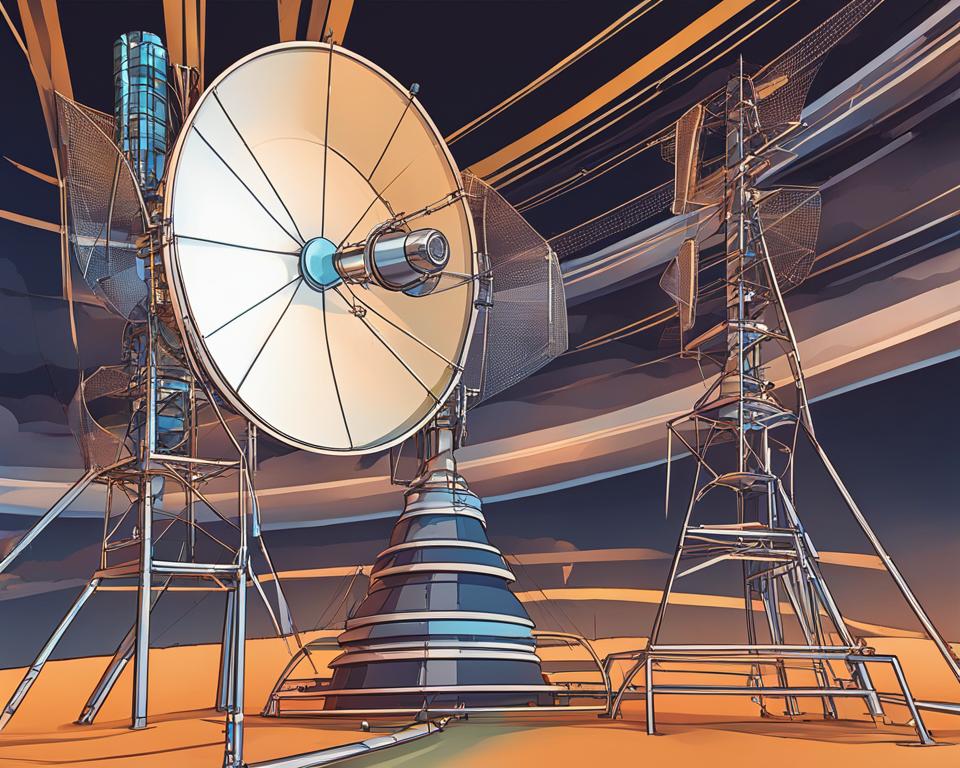
Antennas are specialized transducers that convert electric current into electromagnetic waves and vice versa. They have the ability to transmit and receive nonionizing electromagnetic fields, including radio waves, microwaves, infrared radiation, and visible light. With their diverse shapes and sizes, antennas are designed to operate at specific frequencies, making them a crucial component in signal reception technology.
Key Takeaways:
- An antenna is a transducer that converts electric current into electromagnetic waves and vice versa.
- Antennas can transmit and receive nonionizing electromagnetic fields at specific frequencies.
- Antennas come in various shapes and sizes and are categorized as transmitting or receiving.
- Understanding the basics of antenna technology helps us appreciate their role in wireless communication.
The Electromagnetic Spectrum and Antennas
Understanding the relationship between radio waves and antennas is essential in comprehending the functioning of antennas. Antennas operate within the realm of the electromagnetic spectrum, which encompasses a broad range of electromagnetic radiation. This spectrum is divided into seven distinct fields, including radio waves and microwaves, along with other ranges such as infrared radiation, visible light, ultraviolet, x-rays, and gamma rays.
Antennas primarily function in the radio wave and microwave range. Radio waves have long wavelengths and low frequencies, whereas microwaves possess shorter wavelengths and higher frequencies. Antennas are specifically designed to transmit and receive electromagnetic waves within these particular frequency ranges.
Antennas play a crucial role in facilitating wireless communication by harnessing the power of electromagnetic radiation. By understanding the electromagnetic spectrum and its relationship with antennas, we can gain a deeper appreciation for the technology that enables us to communicate wirelessly.
The Electromagnetic Spectrum
| Electromagnetic Field | Wavelength Range | Frequency Range |
|---|---|---|
| Radio Waves | Approximately 1 kilometer to 1 millimeter | Approximately 3 kilohertz to 300 gigahertz |
| Microwaves | Approximately 1 millimeter to 1 micrometer | Approximately 300 megahertz to 300 gigahertz |
| Infrared Radiation | Approximately 1 micrometer to 700 nanometers | Approximately 300 gigahertz to 430 terahertz |
| Visible Light | Approximately 700 nanometers to 400 nanometers | Approximately 430 terahertz to 750 terahertz |
| Ultraviolet | Approximately 400 nanometers to 10 nanometers | Approximately 750 terahertz to 30 petahertz |
| X-rays | Approximately 10 nanometers to 0.001 nanometers | Approximately 30 petahertz to 30 exahertz |
| Gamma Rays | Approximately 0.001 nanometers and smaller | Approximately 30 exahertz and higher |
Types of Antennas
When it comes to antennas, there are various types available, each with its own design and use case. Understanding the different antenna types can help you choose the right one for your specific needs. Let’s take a closer look at some of the most common types:
Aperture Antennas
Aperture antennas use openings or apertures to direct the transmission and reception of electromagnetic waves. They are often used in satellite communication and radars, where high directivity is required.
Array Antennas
Array antennas consist of multiple smaller antennas that are interconnected and work together to improve signal reception and transmission. They are commonly used in wireless communication systems, such as cellular networks.
Reflector Antennas
Reflector antennas use a curved surface or reflector to focus or direct electromagnetic waves. They are commonly seen in satellite dishes and parabolic reflector antennas.
Lens Antennas
Lens antennas use embedded lenses to enhance the transmission and reception of electromagnetic waves. They are often used in microwave communication systems and can provide high directivity.
Log Periodic Antennas
Log periodic antennas consist of multiple elements arranged to cover a broad range of frequencies. They are commonly used in television antennas and other applications where a wide frequency range is required.
Microstrip Antennas
Microstrip antennas are printed on circuit boards and are commonly used in wireless communication devices, such as smartphones and Wi-Fi routers.
Traveling-Wave Antennas
Traveling-wave antennas are designed to have a unidirectional wave travel along their length. They are commonly used in radar systems and can provide high gain and directivity.
Wire Antennas
Wire antennas are the simplest and most basic type of antennas. They consist of a straight wire or a loop and are commonly used in radio communication systems.
In summary, there are various types of antennas available, each with its own design and use case. Whether you need high directivity, wide frequency range, or simplicity, there’s an antenna type to suit your needs.
Antenna Categories and Categorization
When it comes to antennas, they can be categorized based on several factors that determine their functionality and performance. These categories include whether the antennas are internal or external, the degree of directionality, impedance matching, antenna feed, and antenna efficiency.
Internal and External Antennas
One way to categorize antennas is based on their placement. Internal antennas are commonly found in portable devices such as smartphones, tablets, and laptops. These antennas are integrated into the device’s casing and are designed for convenience and compactness. On the other hand, external antennas are separate components that are mounted outside the device. They are often used in fixed installations or devices that require a stronger and more reliable signal reception.
Directional Antennas
Directional antennas are another category that refers to antennas that focus their signals in a particular direction. These antennas are designed to provide a concentrated signal in a specific area rather than broadcasting the signal evenly in all directions. They are commonly used in scenarios where a targeted signal is required, such as point-to-point communication or long-distance transmission.
Impedance Matching, Antenna Feed, and Antenna Efficiency
Impedance matching is crucial in antenna design to ensure maximum power transfer between the antenna and the transmitter or receiver. Proper impedance matching minimizes signal losses and improves overall performance. The antenna feed refers to the components that connect the antenna to the transmitter or receiver, including cables and connectors. Antenna efficiency measures the ratio of power output to power input and indicates how effectively the antenna converts electrical signals into electromagnetic waves.
| Antenna Category | Description |
|---|---|
| Internal Antennas | Integrated antennas within portable devices |
| External Antennas | Separate antennas mounted outside the device |
| Directional Antennas | Antennas that focus signals in a specific direction |
| Impedance Matching | Matching antenna impedance with transmitter/receiver impedance for optimal power transfer |
| Antenna Feed | Components connecting the antenna to the transmitter or receiver |
| Antenna Efficiency | Ratio of power output to power input, indicating the effectiveness of the antenna |
Understanding the different categories and aspects of antennas is crucial in selecting the right antenna for specific applications. Whether it’s considering the placement, directional focus, impedance matching, or efficiency, each category plays a significant role in determining the overall performance and effectiveness of the antenna.
The History of Antennas
The history of antennas is closely intertwined with the development of wireless technology. It is fascinating to trace the origins of these essential components that enable communication over long distances. Two pioneers, Heinrich Hertz and Guglielmo Marconi, played pivotal roles in the early advancements of antennas.
“Heinrich Hertz, a German physicist, built the first antennas in 1888 as part of his groundbreaking experiments to demonstrate the existence of electromagnetic waves. His work confirmed the theories put forth by James Clerk Maxwell and laid the foundation for the development of wireless communication. Hertz’s experiments with antennas paved the way for practical applications in the field of telegraphy and telephony.”
Building on Hertz’s experiments, Guglielmo Marconi, an Italian inventor and electrical engineer, made significant advancements in practical antenna design in the late 19th century. Marconi developed wireless telegraphy systems that utilized antennas to transmit and receive signals over long distances. His successful transatlantic radio communication in 1901 marked a major milestone in the history of antennas and wireless technology.
Together, Hertz and Marconi revolutionized the field of wireless communication through their pioneering work on antennas. Their contributions continue to shape modern antenna technology, enabling seamless wireless connectivity across the globe.
| Antenna Pioneer | Contributions |
|---|---|
| Heinrich Hertz | Built the first antennas, proving the existence of electromagnetic waves |
| Guglielmo Marconi | Developed practical antenna systems for wireless telegraphy, achieved transatlantic radio communication |
Antenna Directivity and Gain
Antenna directivity and gain are essential factors in optimizing the performance of antennas. Directivity refers to an antenna’s ability to concentrate radiated power in a particular direction, while gain describes the concentration of radiated power into a solid angle of space. Understanding these concepts allows us to design and use antennas effectively for specific applications.
Beam antennas, such as Yagi-Uda antennas, are a prime example of antennas with high directivity. They are designed to maximize response in a specific direction, which makes them ideal for long-range communication. By focusing the power in a desired direction, beam antennas can achieve greater signal strength and coverage in that direction, while reducing power in undesired directions.
The concept of antenna gain goes hand in hand with directivity. It involves concentrating the radiated power into a defined region of space. Antennas with higher gain have a more focused beam, allowing for increased signal strength and improved communication quality. It’s important to note that antenna gain should not be confused with power amplification, as gain simply refers to the pattern of radiation, not increasing the actual power level.
Benefits of Antenna Directivity and Gain
- Enhanced signal strength in a specific direction
- Improved communication range and coverage
- Reduced interference from surrounding sources
- Increased signal quality and reliability
Antenna directivity and gain play a crucial role in optimizing wireless communication. By focusing the radiated power in a desired direction, antennas can achieve greater signal strength, longer communication range, and improved overall performance.
Table: Comparison of Antenna Directivity and Gain
| Antenna Type | Directivity | Gain |
|---|---|---|
| Omni-directional Antenna | 360° coverage | Low |
| Yagi-Uda Antenna | Highly directional | Medium to high |
| Parabolic Reflector Antenna | Highly directional | High |
| Log Periodic Antenna | Directional | Medium |
By understanding the concept of antenna directivity and gain, we can choose the right antenna for specific applications. Whether it’s for long-range communication, reducing interference, or improving signal quality, antennas with high directivity and gain provide a reliable and efficient solution.
Antenna Bandwidth and Tuning
An important aspect of antenna performance is its bandwidth, which refers to the range of frequencies over which the antenna can effectively transmit and receive signals. Antennas have a limited bandwidth determined by their physical characteristics and design. One common type of antenna is the dipole antenna, which has a bandwidth of approximately 10% to 15% of its resonant frequency.
Tuning an antenna is a crucial step in optimizing its performance. By adjusting the physical dimensions of the antenna or using impedance-matching networks, the antenna can be tuned to resonate at a specific frequency or frequency range. This tuning process ensures that the antenna operates efficiently and maximizes signal transmission and reception.
Impedance matching is another important factor in antenna tuning. It involves adjusting the impedance of the antenna to match that of the transmitter or receiver to ensure maximum power transfer. When the impedance is mismatched, it can lead to signal reflections and a high standing wave ratio (SWR), resulting in signal degradation and reduced antenna efficiency.
| Antenna | Bandwidth | Tuning Method |
|---|---|---|
| Dipole Antenna | Approximately 10% to 15% of resonant frequency | Adjusting physical dimensions or using impedance-matching networks |
| Other Antenna Types | Varies depending on design | Adjusting physical dimensions or using impedance-matching networks |
Proper antenna bandwidth and tuning are essential for achieving optimal performance in wireless communication systems. They ensure that the antenna can effectively transmit and receive signals within the desired frequency range and minimize signal degradation caused by impedance mismatches or inefficient tuning. By understanding the concepts of antenna bandwidth and tuning, engineers can design and optimize antennas for various applications.
Antenna Connection and Impedance Matching
When it comes to connecting antennas to transmitters or receivers, the use of transmission lines is essential. These lines serve as the pathway for the electromagnetic signals to travel between the antenna and the transmitting or receiving equipment. For shorter distances, microstrip lines or striplines are commonly used, while coaxial cables are preferred for longer distances. The choice of transmission line depends on factors such as the desired signal strength, frequency range, and environmental conditions.
Impedance matching plays a crucial role in ensuring efficient signal transfer between the antenna and the transmission line. The impedance of the transmission line needs to match that of the antenna and the transmitter/receiver for maximum power transfer. If there is an impedance mismatch, it can lead to signal reflections and a high standing wave ratio (SWR), resulting in significant signal losses. To overcome impedance mismatches, LC impedance-matching networks are commonly used. These networks help to match the impedance of the antenna to that of the transmission line, optimizing the performance of the antenna system.
Proper antenna connection and impedance matching are vital for achieving optimal signal transmission and reception. By ensuring the right transmission line is selected and implementing effective impedance-matching techniques, the efficiency of the antenna system can be significantly improved. This, in turn, enhances the overall performance and reliability of wireless communication systems.
“The right choice of transmission line and effective impedance matching are crucial for maximizing the performance of an antenna system.”
| Transmission Line Type | Advantages | Disadvantages |
|---|---|---|
| Microstrip Lines | – Suitable for short distances and compact designs – Easy integration with printed circuit boards |
– High losses at higher frequencies – Limited power handling capabilities |
| Striplines | – Low losses – Wide frequency range – Good power handling capabilities |
– Complex construction and assembly – Higher cost compared to microstrip lines |
| Coaxial Cables | – Excellent shielding from external interference – Low signal losses – High power handling capabilities |
– Bulky and less flexible compared to microstrip lines – Higher cost compared to microstrip lines |
Table: Comparison of Transmission Line Types
Antenna Efficiency and Design
When it comes to antennas, efficiency plays a crucial role in their performance. Antenna efficiency is the measure of how well an antenna converts electrical power into radiated waves. It is the ratio of power output to power input and takes into account various losses that occur in the antenna system. These losses include I2R losses, dielectric losses, and losses from coupling to other devices.
Designing an efficient antenna involves careful consideration of factors such as resonance frequency, radiation patterns, and impedance matching. The resonant frequency is the frequency at which the antenna operates most efficiently and is determined by its physical dimensions. Antennas are designed to be resonant at specific frequencies, allowing them to transmit and receive signals effectively within that frequency range.
Antenna design is a specialized field that combines theoretical knowledge with empirical work and experimentation. While simple antennas like dipoles can be designed by non-experts, more complex designs often require expertise in RF engineering. For most non-experts, it is recommended to use commercially available antennas that have been designed and optimized for specific applications. These antennas have undergone rigorous testing and provide optimal performance in their respective frequency ranges.
Antenna DIY vs. Commercial Antennas
When it comes to antennas, you may find yourself wondering whether it’s worth designing your own or if commercial options are the better choice. While DIY antenna projects can be a fun and rewarding endeavor, it’s important to consider your level of expertise in RF engineering. Antenna design requires a solid understanding of theoretical principles, empirical work, and extensive experimentation, making it a complex field best suited for professionals.
In contrast, commercial antennas offer a wide range of options designed to meet various needs and requirements. Whether you’re looking for an antenna for a specific frequency range or a specialized application, there’s likely a commercially available solution that fits the bill. High-volume applications even offer the possibility of getting special antennas designed to meet your unique specifications.
Ultimately, the decision between DIY and commercial antennas depends on your specific circumstances and goals. If you’re an RF engineering expert looking for a challenging project, designing your own antenna can be a rewarding experience. However, for most non-experts, it’s recommended to explore the wide variety of commercial antennas available on the market. These antennas have been designed, tested, and optimized for optimal performance, ensuring reliable signal reception and transmission.
Table: Pros and Cons of Antenna DIY and Commercial Antennas
| Antenna DIY | Commercial Antennas |
|---|---|
| + Customization potential | + Wide variety of options |
| + Learning experience | + Designed for optimal performance |
| + Satisfaction of building your own | + Tested and optimized for reliability |
| – Requires expertise in RF engineering | – Limited customization for specific needs |
| – Time-consuming experimentation | – Cost may be higher than DIY |
Table: Pros and Cons of Antenna DIY and Commercial Antennas
As shown in the table above, antenna DIY projects offer the potential for customization, a learning experience, and the satisfaction of building your own equipment. However, these advantages come with the requirement for expertise in RF engineering and the time-consuming nature of experimentation. On the other hand, commercial antennas provide a wide range of options designed for optimal performance, reliability, and ease of use. While customization may be limited, the availability of tested and optimized commercial solutions outweighs this constraint in many cases.
Conclusion
Antennas play a vital role in communication technology, allowing us to transmit and receive electromagnetic waves. By understanding how antennas work and the different types available, we can appreciate their significance in wireless communication. Whether utilizing commercial antennas or designing custom solutions, antennas continue to evolve and shape the way we communicate.
Antennas are specialized transducers that convert electric current into electromagnetic waves or vice versa. They can transmit and receive nonionizing electromagnetic fields, such as radio waves and microwaves. With their diverse shapes and sizes, antennas are designed to operate at specific frequencies, enabling efficient signal transmission and reception.
In the world of antenna technology, there are various types to choose from. Whether it’s aperture antennas, array antennas, reflector antennas, lens antennas, log periodic antennas, microstrip antennas, traveling-wave antennas, or simple wire antennas, each type has its own design and use case. These antennas serve different purposes, such as focusing signals in a specific direction or providing a broad frequency range.
FAQ
How does an antenna work?
An antenna is a specialized transducer that converts electric current into electromagnetic waves or vice versa. It can transmit and receive nonionizing electromagnetic fields, such as radio waves, microwaves, infrared radiation, and visible light.
What are the main types of antennas?
There are various types of antennas, including aperture antennas, array antennas, reflector antennas, lens antennas, log periodic antennas, microstrip antennas, traveling-wave antennas, and simple wire antennas.
How are antennas categorized?
Antennas can be categorized based on factors such as whether they are internal or external, their degree of directionality, and their impedance matching.
What is the history of antennas?
Antennas have a rich history in wireless technology, with pioneers such as Heinrich Hertz and Guglielmo Marconi making significant contributions.
What is antenna directivity and gain?
Antenna directivity refers to its ability to concentrate radiated power in a particular direction, while antenna gain describes the concentration of radiated power into a solid angle of space.
What is antenna bandwidth and tuning?
Antenna bandwidth refers to its ability to transmit and receive signals within a specific frequency range, and antennas can be tuned by adjusting their physical dimensions or using impedance-matching networks.
How are antennas connected and matched to transmitters/receivers?
Antennas are connected to transmitters or receivers using transmission lines, such as microstrip lines or coaxial cables. Impedance matching ensures maximum power transfer between the antenna and the transmitter/receiver.
What is antenna efficiency and design?
Antenna efficiency is the ratio of power output to power input, and it accounts for losses in the antenna. Antenna design is a specialized field that involves theoretical knowledge, empirical work, and experimentation.
Should I try to design my own antennas?
Designing your own antenna can be challenging unless you have expertise in RF engineering. For most non-experts, it is recommended to buy commercially available antennas that suit their needs.