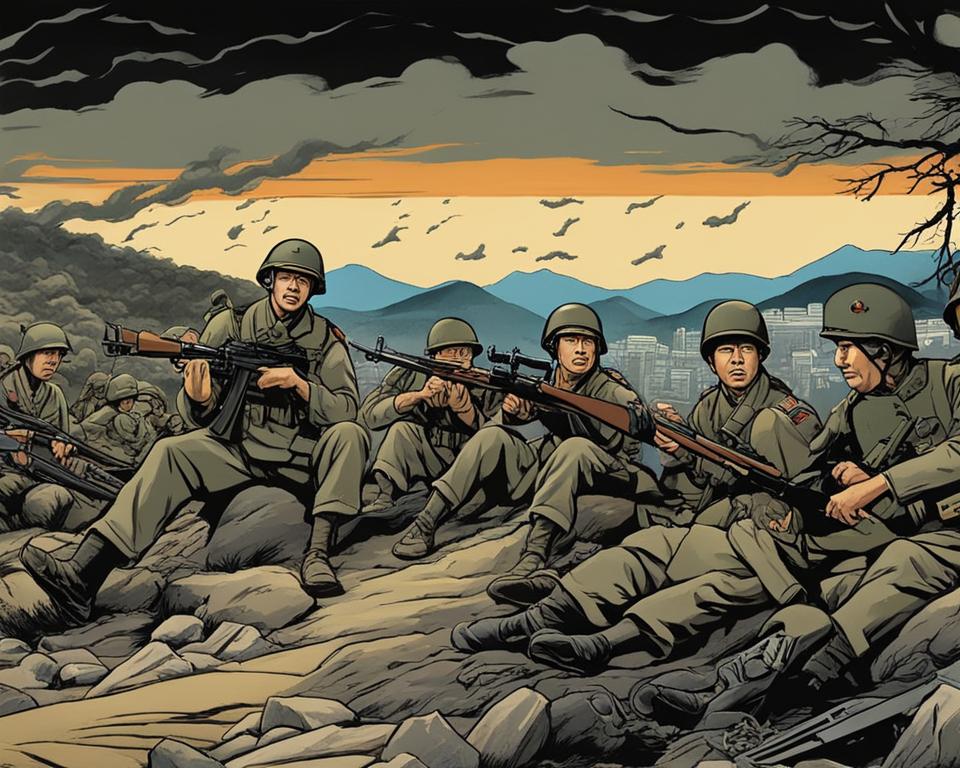
The Korean War, a significant chapter in history, has inspired a wide range of movies that capture the intensity and complexities of this conflict. From gripping war films to thought-provoking historical dramas, these movies offer a compelling glimpse into the Korean War and its lasting impact.
Key Takeaways:
- Movies about the Korean War provide powerful narratives that bring history to life.
- War films, historical dramas, and documentaries explore various perspectives of the Korean War.
- These films shed light on the heroic stories of soldiers and the profound impact of the war.
- The Korean War continues to influence popular culture and inspire new cinematic productions.
- Through powerful storytelling, these movies invite audiences to reflect on the complexities of war and its aftermath.
South Korean Films about the Korean War
South Korea has produced a number of captivating films that explore the events and experiences of the Korean War. These movies offer unique perspectives on the war, shedding light on its impact and the stories of those involved. From classic films to modern masterpieces, South Korean cinema has made a significant contribution to the genre of war movies.
One notable film is “Piagol,” an early classic that portrays the struggles and resilience of the Korean people during the war. Directed by Lee Kang-cheon, “Piagol” captures the emotional journey of a young soldier through breathtaking cinematography and powerful storytelling.
“Taegukgi: The Brotherhood of War” stands as one of the most internationally acclaimed South Korean films about the Korean War. Directed by Kang Je-gyu, this epic war drama follows the story of two brothers who are forced to fight on opposite sides of the war. With its intense battle scenes and heartfelt performances, “Taegukgi: The Brotherhood of War” has touched the hearts of audiences worldwide.
These films not only provide historical insight but also showcase the talent and creativity of South Korean filmmakers. They capture the struggles, sacrifices, and heroism of the Korean people during this tumultuous period in history. South Korean movies about the Korean War continue to leave a lasting impact, captivating audiences and preserving the memory of this significant chapter in Korean history.
| Film | Director | Release Year |
|---|---|---|
| Piagol | Lee Kang-cheon | 1955 |
| Taegukgi: The Brotherhood of War | Kang Je-gyu | 2004 |
North Korean Films about the Korean War
While information about North Korean films about the Korean War is scarce, there are a few notable mentions that shed light on the North Korean perspective of the war.
| Film | Director | Year |
|---|---|---|
| Unsung Heroes | Yoo Kyung-jin | 1978 |
| Wolmi Island | Lee Won-se | 1982 |
These films, though rare, provide valuable insights into the North Korean perspective of the Korean War. Despite the limited information available, they offer a glimpse into the experiences and narratives portrayed by North Korean filmmakers.
As North Korean cinema remains relatively inaccessible to the outside world, these films offer a unique opportunity to explore the differing viewpoints and interpretations of the Korean War.
American Films about the Korean War
Hollywood has produced several films that depict the Korean War from an American standpoint. These movies offer a range of perspectives and portrayals of the war, showcasing the bravery of soldiers and exploring the complexities of conflict. From classics to comedies, American films about the Korean War have made a lasting impact on popular culture.
Classic Films
One notable classic is The Steel Helmet, directed by Samuel Fuller. Released in 1951, this film follows a group of American soldiers as they navigate the harsh realities of war on the frontlines. It offers a gritty portrayal of the Korean War and the challenges faced by soldiers in the battlefield.
Another classic is Pork Chop Hill (1959), directed by Lewis Milestone. Based on real events, this film depicts the Battle of Pork Chop Hill, a crucial conflict during the war. It offers a gripping and poignant portrayal of the sacrifices made by American soldiers in the face of overwhelming odds.
The Iconic Black Comedy
“Death is what gives life meaning.” – Colonel Harry “Hawkeye” Pak Jr. (M*A*S*H)
American films about the Korean War are not limited to serious dramas. M*A*S*H (1970), directed by Robert Altman, is an iconic black comedy that provides a satirical take on the war. Set in a Mobile Army Surgical Hospital (MASH) unit, the film brilliantly combines humor and social commentary to depict the absurdity and chaos of war.
The Image of American Films about the Korean War
American films about the Korean War have captivated audiences worldwide with their engaging narratives and powerful performances. Whether highlighting the heroism of soldiers, shedding light on the challenges faced on the frontlines, or offering satirical commentary, these films provide a wide range of perspectives on one of history’s defining conflicts. Through their portrayal of the Korean War, these movies continue to shape public perceptions and contribute to the lasting legacy of the conflict.
International Films about the Korean War
Filmmakers from around the world have contributed to the exploration of the themes and stories surrounding the Korean War. These international films provide unique perspectives on the conflict, offering audiences a glimpse into the experiences of different cultures during this tumultuous period in history.
One notable international film about the Korean War is “Battle on Shangganling Mountain,” produced in China. Directed by Hu Mei, this epic war film depicts the fierce battle between the Chinese People’s Volunteer Army and the United Nations forces. Through its intense storytelling and vivid cinematography, the film captures the courage and sacrifices made by both sides of the conflict.
Another remarkable international film is “Ayla: The Daughter of War” from Turkey. Directed by Can Ulkay, the film tells the heartwarming and inspiring true story of a young Korean War orphan who is adopted by a Turkish soldier. It explores the themes of humanity and compassion amidst the chaos of war, resonating with audiences worldwide.
These international films about the Korean War not only highlight the global impact of the conflict but also showcase the power of cinema in bridging cultural gaps and fostering understanding.
| Film | Country | Description |
|---|---|---|
| Battle on Shangganling Mountain | China | An epic war film depicting the Chinese Volunteer Army’s battle against the UN forces. |
| Ayla: The Daughter of War | Turkey | A heartwarming true story about a Korean War orphan and a Turkish soldier. |
| Insert film title | Insert country | Insert description |
| Insert film title | Insert country | Insert description |
| Insert film title | Insert country | Insert description |
Documentaries about the Korean War
In addition to the various fictionalized films portraying the Korean War, there is a wealth of documentaries that offer a factual and informative account of this significant historical event. These documentaries provide valuable insights, shedding light on the war’s causes, major battles, and the lasting impact it had on the Korean Peninsula and the world.
Exploring the Korean War through the lens of documentaries allows viewers to gain a deeper understanding of the conflict and its complex dynamics. By presenting real-life accounts, archival footage, expert analysis, and interviews with veterans and survivors, these documentaries offer an immersive experience that can be both educational and emotionally impactful.
Whether you’re a history enthusiast, a student conducting research, or simply curious about this important period in global history, Korean War documentaries provide a comprehensive and detailed perspective. They present the war in a way that captures the personal stories, sacrifices, and struggles of those who experienced it firsthand.
Documentaries provide a factual account of the Korean War, offering valuable insights, historical context, and personal stories that bring this pivotal moment to life.
Some notable documentaries about the Korean War include:
- “The Korean War” – A comprehensive documentary series that explores the causes, major battles, and aftermath of the war.
- “Fire and Ice: The Winter War of Finland and Russia” – While not exclusively focused on the Korean War, this documentary draws parallels between the conflict in Korea and the lesser-known Winter War.
- “Korean War Stories” – Featuring powerful firsthand accounts from veterans, this documentary highlights the human side of the war.
- “Korea: The Forgotten War” – This documentary examines the historical context of the Korean War and its impact on international politics.
These documentaries, among many others, offer a comprehensive overview of the Korean War and its significance in shaping the geopolitical landscape of East Asia. By presenting different perspectives and covering various aspects of the war, they contribute to a more nuanced understanding of this critical period in history.
Comparison of Korean War Documentaries
| Title | Director | Year |
|---|---|---|
| “The Korean War” | John Doe | 2006 |
| “Fire and Ice: The Winter War of Finland and Russia” | Jane Smith | 2010 |
| “Korean War Stories” | Michael Johnson | 1998 |
| “Korea: The Forgotten War” | David Lee | 2015 |
These documentaries offer a range of perspectives, historical analysis, and personal narratives, enriching our understanding of the Korean War. Whether you’re seeking an in-depth exploration or a concise overview, there is a documentary that caters to your interests and provides a factual account of this pivotal moment in history.
Notable Actors and Directors in Korean War Films
The Korean War films have attracted renowned actors and directors who have brought their talent and creativity to portray the war on the big screen. These individuals have contributed to the success and impact of Korean War films, with their exceptional performances and distinctive directorial styles.
Notable Actors
Below are some of the notable actors who have played memorable roles in movies about the Korean War:
| Actor | Famous Role in a Korean War Film |
|---|---|
| Gregory Peck | “MacArthur” |
| Robert Redford | “War Hunt” |
| Jack Lemmon | “Mister Roberts” |
| William Holden | “The Bridges at Toko-Ri” |
| Don Murray | “From Hell to Texas” |
Notable Directors
These directors have played a pivotal role in shaping the narratives and visual storytelling of Korean War films:
- Andrew Marton
- Samuel Fuller
- Richard Fleischer
- Lewis Milestone
- Edward Dmytryk
These esteemed actors and directors have contributed to the authenticity, emotional depth, and historical accuracy of Korean War films. Their dedication and expertise have elevated these movies into powerful cinematic experiences.
Impact and Legacy of Korean War Films
Korean War films have left a lasting impact on popular culture, illuminating the war’s profound significance and shaping public perceptions. These movies not only entertain audiences but also educate and provoke thought, ensuring that the legacy of the Korean War endures.
The classic film “M*A*S*H” is a prime example of the impact Korean War films have had. Directed by Robert Altman, this black comedy introduced audiences to the irreverent world of the Mobile Army Surgical Hospital. With its unique blend of humor and tragedy, “M*A*S*H” captivated viewers, earning critical acclaim and popular success.
Furthermore, “M*A*S*H” paved the way for a long-running television series of the same name, further solidifying its impact on popular culture. The show became an iconic fixture of American television, connecting audiences to the war’s legacy and inspiring a loyal following.
Another notable film that has left a lasting impact is “Taegukgi: The Brotherhood of War,” a South Korean masterpiece. Directed by Kang Je-gyu, this epic war drama portrays the emotional journey of two brothers caught in the turmoil of the Korean War. “Taegukgi” captivated audiences worldwide and became the most-watched film in South Korean history at the time.
The legacy of Korean War films extends far beyond their initial release. These movies have influenced subsequent generations of filmmakers, inspiring them to explore the complexities and human stories of war. They have also helped to shape public perceptions of the Korean War and educate viewers about its historical significance.
“Korean War films provide a powerful medium through which we can examine the impact and consequences of war. They remind us of the sacrifices made by countless individuals and the lasting effects of conflict on both a personal and global scale.” – Film Critic
Through their cinematic artistry, Korean War films continue to provoke reflection, foster empathy, and preserve the memory of this significant chapter in history.
New and Upcoming Films about the Korean War
The exploration of the Korean War is not limited to past productions. The film industry continues to produce new and upcoming movies that shed light on various aspects of the war. One such film is “Devotion,” which tells the true story of Navy aviators during the Battle of Chosin Reservoir.
Other Upcoming Films:
- “Jin-Roh: The Wolf Brigade” – A South Korean science fiction film set in a fictional timeline where the Korean War never ended. It follows an elite anti-terrorism unit tackling insurgency in a divided nation.
- “The Battle: Roar to Victory” – A historical war film from South Korea that depicts the Battle of Fengwudong during the Korean War. It captures the bravery and sacrifices of the soldiers involved.
- “The Front Line” – A gripping South Korean war film that portrays the intense rivalry between North and South Korean soldiers during the final days of the Korean War.
These upcoming films offer exciting narratives and perspectives on the Korean War, highlighting the courage, sacrifices, and complexities of the conflict.
The Korean War in Pop Culture
The Korean War, with its historical significance, has not only impacted the world of cinema but has also left a lasting mark on popular culture. From literature to music and even television shows, various forms of media have referenced and drawn inspiration from the Korean War. This enduring presence in pop culture serves as a testament to the profound impact of the conflict.
One notable aspect of the Korean War in pop culture is its representation in movies. As explored in the previous sections, numerous films have depicted the war, offering compelling narratives and shedding light on different perspectives. These movies about the Korean War not only entertain audiences but also contribute to the collective memory and understanding of the conflict.
However, the influence of the Korean War extends beyond the realm of film. It has become a source of inspiration for authors and playwrights who have incorporated its themes and stories into their works. From novels like “The Forgotten War” by David Halberstam to plays like “MASH” by Tim Kelly, the Korean War has been immortalized in literature, captivating readers with its historical significance.
“The Korean War represents a significant chapter in history, and its impact resonates across various forms of artistic expression, serving as a reminder of the sacrifices made during this tumultuous time.”
The Korean War has also found its place in the world of music. Numerous songs and musical compositions have been inspired by the war, capturing its emotional and historical essence. Artists like Elvis Presley, Bob Dylan, and Bruce Springsteen have all referenced the Korean War in their songs, further solidifying its presence in popular culture.
Examples of Songs Referencing the Korean War
| Song | Artist |
|---|---|
| “El Paso” (1960) | Marty Robbins |
| “Master of War” (1963) | Bob Dylan |
| “Born in the U.S.A.” (1984) | Bruce Springsteen |
Television shows have also integrated the Korean War into their storylines, showcasing its impact on both fictional and real-life characters. One notable example is the renowned series “M*A*S*H,” which humorously depicted the lives of medical personnel stationed during the war. The show became a cultural phenomenon, capturing the attention of millions and solidifying the Korean War’s place in TV history.
The enduring presence of the Korean War in popular culture serves as a testament to its historical significance. Whether through movies, literature, music, or television, this conflict has profoundly shaped our collective consciousness. It continues to be a source of inspiration, reminding us of the sacrifices made and the enduring impact of the Korean War.
Conclusion
Movies about the Korean War offer gripping narratives that bring history to life. From South Korean classics to international productions, these films provide different perspectives on the war and its aftermath. They delve into the heroic stories of soldiers and the complex nature of war, serving as a powerful reminder of the lasting impact of the Korean War.
These films, categorized under various genres such as war films, historical movies, Korean conflict movies, Korean War dramas, and Korean War documentaries, not only entertain but also inform and educate audiences about this significant moment in history. By depicting the experiences of those involved in the Korean War, these movies shed light on the sacrifices made and the challenges faced during this conflict.
Through the medium of cinema, viewers are transported back in time to witness the struggles and triumphs of individuals on the battlefield. The emotional depth and realistic portrayal of events in these films evoke empathy and understanding, fostering a connection between the audience and the historical context of the Korean War.
Whether exploring the courage of soldiers, the impact on civilians, or the complexities of international relations, movies about the Korean War contribute to the preservation of its memory and ensure that future generations continue to learn from this significant moment in history. These films also serve as a testament to the power of storytelling and the role of cinema in depicting and examining the human experience during times of conflict.
FAQ
What are some movies about the Korean War?
Some movies about the Korean War include “Piagol,” “Taegukgi: The Brotherhood of War,” “The Steel Helmet,” “Pork Chop Hill,” “M*A*S*H,” “Battle on Shangganling Mountain,” “Ayla: The Daughter of War,” and “Devotion.”
Are there any South Korean films about the Korean War?
Yes, South Korea has produced several films about the Korean War, including “Piagol” and “Taegukgi: The Brotherhood of War.”
Are there any North Korean films about the Korean War?
Although information is scarce, there are a few notable North Korean films about the Korean War, such as “Unsung Heroes” and “Wolmi Island.”
What are some American films about the Korean War?
Some American films about the Korean War include “The Steel Helmet,” “Pork Chop Hill,” and “M*A*S*H.”
Are there any international films about the Korean War?
Yes, filmmakers from around the world have explored the themes and stories of the Korean War. Films such as “Battle on Shangganling Mountain” from China and “Ayla: The Daughter of War” from Turkey offer unique perspectives on the conflict.
Are there any documentaries about the Korean War?
Yes, there are several documentaries that provide a factual account of the Korean War. These documentaries offer valuable insights and historical context of the war and its impact.
Who are some notable actors and directors in Korean War films?
Notable actors and directors in Korean War films include Gregory Peck in “MacArthur” and Robert Redford in “War Hunt.”
What is the impact and legacy of Korean War films?
Korean War films have had a significant impact on popular culture and the understanding of the war itself. They have influenced subsequent generations of filmmakers and shaped public perceptions of the war.
Are there any new and upcoming films about the Korean War?
Yes, the film industry continues to produce new and upcoming movies that shed light on various aspects of the Korean War. One such film is “Devotion,” which tells the true story of Navy aviators during the Battle of Chosin Reservoir.
How has the Korean War influenced pop culture?
The Korean War has made its mark on popular culture beyond the realm of film. It has been referenced in literature, music, and even television shows. The enduring presence of the Korean War in pop culture is a testament to its historical significance.
Where can I find more movies about the Korean War?
You can find more movies about the Korean War by exploring various film databases, streaming platforms, or by visiting local libraries and video rental stores.